Additive Manufacturing Workflows: The Key to Experiential Product Prototyping and Scalable Industrial Solutions
In the rapidly evolving landscape of modern manufacturing, additive manufacturing (AM) workflows have emerged as a transformative force, redefining how products are designed, prototyped, and produced. Unlike traditional subtractive manufacturing methods, which rely on cutting away material to achieve the desired shape, additive manufacturing builds objects layer by layer from digital models. This shift not only enhances flexibility but also unlocks new possibilities for innovation, sustainability, and efficiency in industrial processes.
The Rise of Additive Manufacturing in Industrial Workflows
Additive manufacturing, often synonymous with 3D printing, has transcended its initial role as a tool for rapid prototyping to become a cornerstone of scalable industrial solutions. Its ability to produce complex geometries with minimal waste has made it an attractive option for industries ranging from aerospace to healthcare. By integrating AM into existing workflows, manufacturers can reduce lead times, lower costs, and accelerate time-to-market for new products.
One of the most significant advantages of additive manufacturing is its compatibility with digital twin manufacturing. Digital twins—virtual replicas of physical systems—allow manufacturers to simulate and optimize AM processes before committing to physical production. This synergy enables real-time process analytics, ensuring that every layer of material is deposited with precision, reducing defects, and improving overall product quality. The result is a seamless blend of digital and physical manufacturing, where data-driven insights guide every step of the production cycle.
Experiential Product Prototyping: Bridging Design and Reality
Traditional prototyping methods often involve lengthy iterations, with each design change requiring new tooling or molds. Additive manufacturing eliminates these bottlenecks by enabling experiential product prototyping—an approach where designers and engineers can quickly produce and test physical models directly from digital designs. This agile manufacturing process fosters creativity and innovation, allowing teams to explore multiple design variations in a fraction of the time.
For example, in the automotive industry, AM workflows enable engineers to prototype intricate components like custom dashboard interfaces or lightweight structural parts. These prototypes can be tested for fit, form, and function in real-world conditions, providing invaluable feedback before mass production begins. The ability to iterate rapidly not only improves product quality but also enhances customer-integrated design, where end-user preferences are incorporated early in the development process.
Human-Centric Production in Additive Manufacturing
While additive manufacturing is often associated with automation, its success hinges on human-centric production principles. Skilled technicians and engineers play a critical role in overseeing AM workflows, from preparing digital models to post-processing finished parts. Tech-enabled workforce training ensures that employees are equipped with the knowledge and tools to leverage AM technologies effectively, fostering a culture of continuous improvement and lean operational excellence.
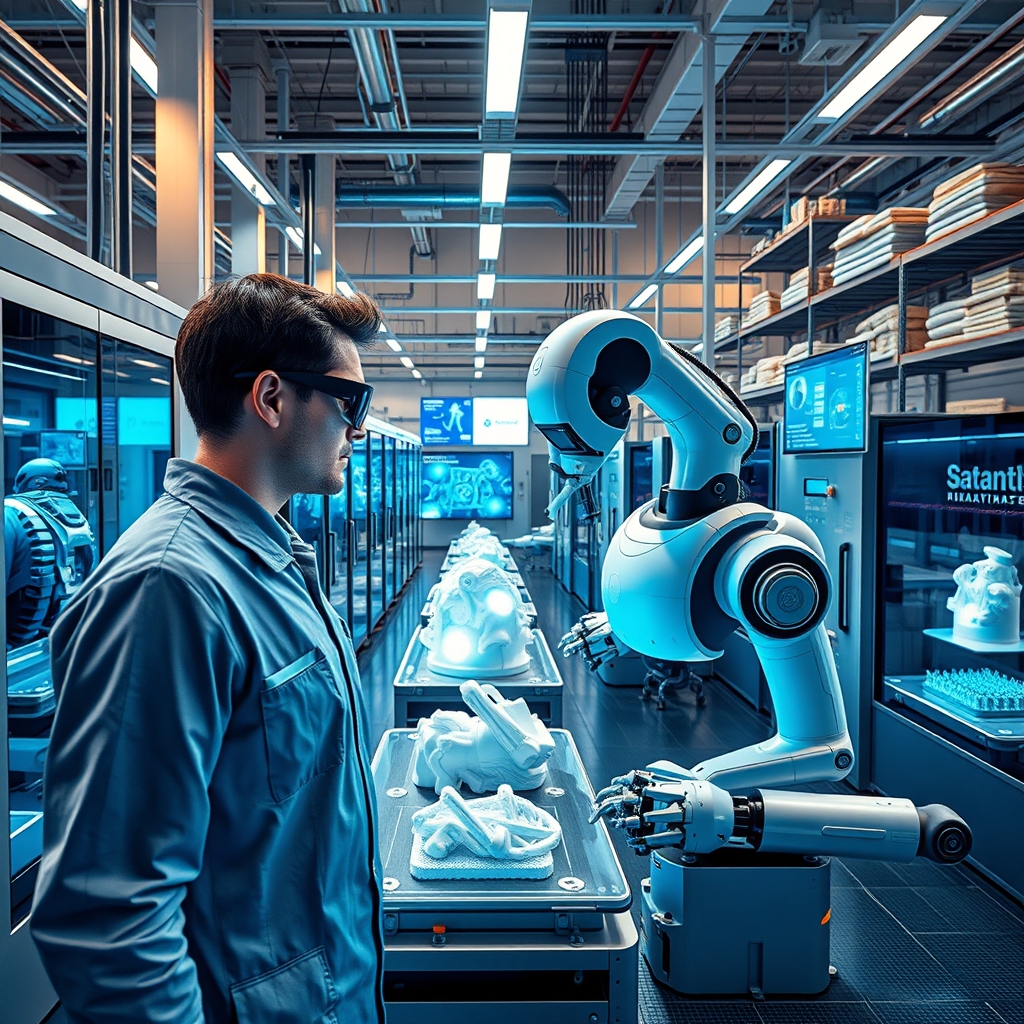
Moreover, collaborative robotics deployment is increasingly being integrated into AM workflows to enhance efficiency and safety. Robots can handle repetitive tasks such as material loading, part removal, and post-processing, freeing up human workers to focus on higher-value activities like quality control and process optimization. This collaboration between humans and machines exemplifies the future of manufacturing, where technology augments rather than replaces human expertise.
Sustainable and Scalable Industrial Solutions
Sustainability is a driving force behind the adoption of additive manufacturing. By minimizing material waste and energy consumption, AM workflows align with the principles of a sustainable supply chain. Unlike traditional manufacturing, which often generates significant scrap material, additive manufacturing uses only the material required to build the part, reducing environmental impact. Additionally, AM enables on-demand production, eliminating the need for large inventories and reducing the carbon footprint associated with storage and transportation.
Scalability is another key advantage of additive manufacturing. While AM was once limited to small-scale production, advancements in technology have made it viable for large-scale industrial applications. Modular manufacturing systems, for instance, allow manufacturers to scale production up or down based on demand, without the need for costly retooling. This flexibility is particularly valuable in industries with fluctuating market demands, such as consumer electronics or medical devices.
Preventive Equipment Maintenance and Data-Driven Efficiency
Additive manufacturing workflows are not immune to equipment wear and tear, but preventive equipment maintenance strategies can mitigate downtime and ensure consistent performance. By leveraging real-time process analytics, manufacturers can monitor the health of AM machines, detecting anomalies before they lead to failures. Predictive maintenance algorithms analyze data from sensors embedded in the equipment, providing actionable insights that extend the lifespan of machines and reduce unplanned downtime.
Data-driven production efficiency is at the heart of AM workflows. Every layer of material deposited, every temperature fluctuation, and every print speed adjustment generates data that can be used to optimize future builds. By harnessing this data, manufacturers can fine-tune their processes, improve repeatability, and achieve higher levels of precision. This level of control is particularly critical in industries where even minor deviations can compromise product performance, such as aerospace or medical implants.
As additive manufacturing continues to evolve, its integration with other Industry 4.0 technologies will further enhance its capabilities. From digital twins to collaborative robotics, the future of AM workflows lies in creating interconnected, intelligent systems that drive innovation and efficiency. The shift toward experiential prototyping, sustainable practices, and scalable solutions is not just a trend—it’s a fundamental reimagining of how products are brought to life. The factories of tomorrow will be defined by their ability to adapt, innovate, and deliver value in ways that were once unimaginable, all while keeping the human element at the center of production.